
Custom Acrylic Backlit Signs vs LED Neon Signs: What's the Difference?
, by Freedom Neon, 7 min reading time
, by Freedom Neon, 7 min reading time
Acrylic backlit signs and LED neon signs are often confused — both use LED neon tube lighting, both are custom-made, and both show up in similar spaces. But they're built differently and suit different kinds of designs. This guide explains what a custom acrylic backlit sign actually is, how it compares to neon in terms of light direction, line detail, and price, and which one is likely the better fit for your branding. If you're considering a sign for a beauty salon, hair studio, nail bar, or similar space, this is a good place to start.
If you've been searching for a neon sign and keep coming across a certain style — metal lettering on a glowing panel, a soft light around the edges, a polished finish that looks more like a boutique storefront than a bar sign — there's a good chance what you're actually looking at is an acrylic backlit sign.
The two are often grouped together, and it's an easy mix-up to make. Both use LED neon tube lighting. Both are custom-made. Both are used in similar settings. But they're built differently, they look different, and they suit different kinds of designs and spaces.
This guide breaks down what acrylic backlit signs actually are, how they compare to neon, and which one is likely the better fit for what you have in mind.
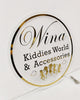
An acrylic backlit sign is made up of two main components: a precision-cut acrylic panel and a metal appliqué layer applied to the front surface. LED neon tube is installed around the perimeter of the back panel, casting a soft glow from behind.

When you look at the finished sign, what you see on the front is a clean metallic surface — lettering, a logo, or a graphic element — in whichever metal finish was chosen. The light doesn't come through the lettering itself. Instead, it radiates from behind and around the panel, framing the design with a subtle ambient glow.
This is a fundamentally different construction from a neon sign, where the LED tube itself forms the letters or shapes and emits light directly from the front.
The result is a sign that reads as more refined and architectural — less about the glow, more about the surface and the craftsmanship.
Neon signs emit light from the front. The tube is the design — glowing, vivid, immediately eye-catching. The visual impact is direct and strong, and it reads clearly from a distance. This is what gives neon its characteristic energy.
Acrylic backlit signs emit light from behind. The metallic front surface is what carries the design, and the lighting plays a supporting role — creating depth and atmosphere without competing with the sign itself. The overall effect is softer and more ambient.
Neon tubing has a consistent line weight throughout — typically 6mm, 8mm, or 12mm depending on the style. This is part of what defines the neon aesthetic, but it also means that very fine or intricate details in a logo may not translate cleanly.

Acrylic backlit signs work differently. Metal appliqués can be cut to a minimum width of 3mm, which makes it possible to capture finer lines and more detailed logo marks. For details finer than 3mm, UV printing directly onto the acrylic surface can be used to preserve the full resolution of the original design.
At equivalent sizes, acrylic backlit signs are generally more cost-effective than neon. The material requirements and production process differ, and the overall cost tends to be lower — which makes it a practical option for businesses that want a high-end look without a higher price point.
When Each Works Best
Neon is well-suited to bold, high-contrast designs — clean lettering, strong outlines, graphic elements with clear shapes. It works well for spaces that want energy, warmth, and immediate visual presence.
Acrylic backlit signs tend to work better for designs that are more intricate or refined — detailed logo marks, delicate typography, layered branding elements. They suit interiors where the aesthetic is polished and considered, and where the sign needs to feel like part of the space rather than the loudest thing in it.
| Feature | Acrylic Backlit Sign | LED Neon Sign |
|---|---|---|
| Light Direction | Back-lit halo effect with soft ambient glow | Front-facing illumination with direct, vivid light |
| Appearance | Metallic finish with a refined, architectural look | Bright, colorful, and eye-catching neon style |
| Line Detail | Flexible detail reproduction — metal appliqué can capture lines as fine as 3mm | Consistent tube width — typically 6mm, 8mm, or 12mm |
| Best For | Detailed logos, beauty brands, wellness spaces, boutique studios | Bold lettering, graphic designs, bars, restaurants, and entertainment spaces |
| Price | Generally more cost-effective for comparable sizes | Moderate, depending on size, color, and complexity |
Both sign types support single fixed colors and RGB switching. For acrylic backlit signs specifically, warm white and white are by far the most popular choices — both complement metallic finishes exceptionally well, with warm white giving a softer feel and white reading as sharper and more contemporary.
The panel color affects how light behaves across the sign:
Clear — Maximum light transmission and the strongest backlight effect. Best if you want the halo lighting itself to become part of the visual effect.
Frosted or White — A popular choice for salons because the diffused edge creates a softer, more ambient appearance.
Black — Best for luxury interiors where subtle lighting is preferred over maximum brightness. The backlight is visible mainly from the side and rear, letting the metallic front surface do most of the visual work.
Available finishes include: Mirror Gold, Mirror Black, Mirror Silver, Mirror Rose Gold, Brushed Gold, Brushed Black, Brushed Silver, Brushed Rose Gold.

Brushed finishes read as more matte and tactile; mirror finishes are highly reflective and high-gloss. The right choice depends on the overall color palette and aesthetic of the space.
Shape
Round is the most commonly chosen shape — it suits circular logo marks naturally and has a clean, finished quality that works well on feature walls and behind reception desks.
Rectangle or square is the better fit for horizontal wordmarks and logotypes.
Contour cut (shaped to follow the outline of the design) is available for logos where the silhouette itself is part of the identity.
Size
For most interior applications, the practical range is 16 to 36 inches. Round signs can be made up to 45 inches in diameter. As with any custom sign, size and price scale together.
The clearest fit we see, by far, is beauty — salons, hair studios, nail bars, and skincare boutiques. These businesses often have logos built around fine details, elegant typography, delicate floral elements, or layered monograms that simply work better in metal appliqué than in neon tubing. The refined, polished finish of a backlit sign also aligns naturally with the aesthetic most beauty studios are working hard to create — the kind of space where every detail signals care and quality.
Beyond beauty, acrylic backlit signs do occasionally appear in other settings: boutique retail and fashion stores that want a quieter, more understated presence; spas and wellness studios where a soft glow suits the calm of the environment; restaurants or cafés with a curated interior where the sign should complement rather than compete; and corporate reception areas that want a professional finish without the informality that neon can sometimes carry.
These are less common in our experience, but they share the same underlying logic — the design and the space call for something refined rather than bold.
There's no single right answer between acrylic backlit signs and LED neon signs. The right choice depends on your design, your branding, and the atmosphere you want to create.
If you're unsure which style will look better in your space, send us your logo. We'll prepare mockups of both an acrylic backlit sign and an LED neon sign, explain the differences, and recommend the option that best suits your branding — all before you place an order.


